
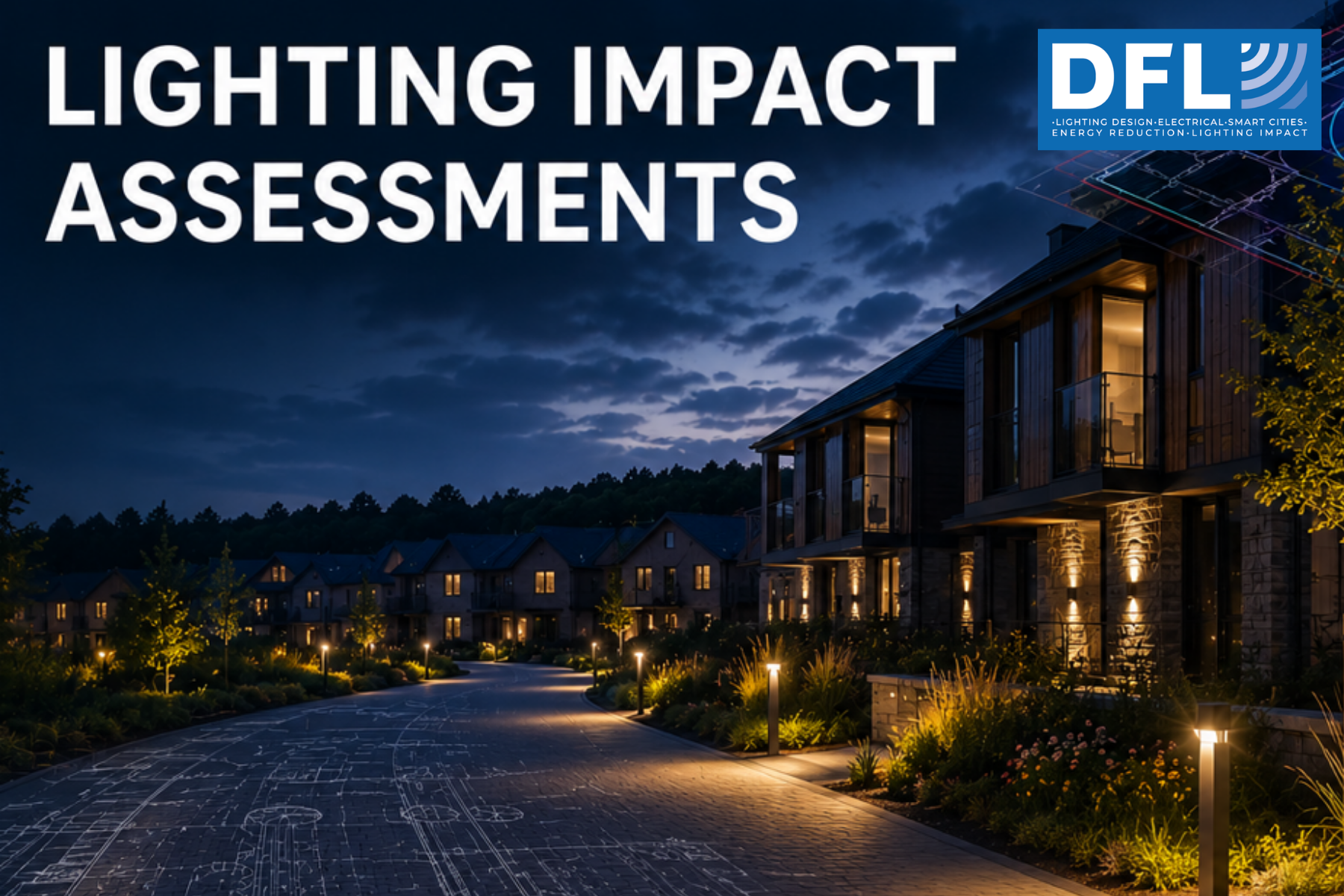
Professional Lighting Impact Assessments for UK Planning Applications
A professionally prepared lighting impact assessment is increasingly essential for UK planning applications involving external lighting. Local planning authorities now place significant emphasis on reducing light pollution, controlling glare and spill, and protecting environmentally sensitive locations.
At DFL, we provide technically robust Lighting Impact Assessment Reports designed to support planning submissions for outdoor lighting schemes across the UK. Our assessments evaluate the environmental effects of artificial lighting, helping developers, consultants, and local authority project teams demonstrate that proposed lighting installations are appropriate, proportionate, and aligned with recognised industry guidance.
Whether your project involves residential development, sports lighting, highways infrastructure, commercial premises, or public realm improvements, our reports provide clear evidence-based analysis to support the planning process.
What is a Lighting Impact Assessment?
A lighting impact assessment is a technical study that evaluates how artificial lighting may affect surrounding environments, nearby properties, road users, wildlife habitats, and dark skies.
The purpose of the assessment is to identify and mitigate potential adverse impacts associated with external lighting, including:
- Light spill beyond site boundaries
- Disability glare and visual discomfort
- Sky glow and light pollution
- Ecological impacts on bats and nocturnal species
- Intrusive light affecting residential receptors
- Potential conflicts with planning policy and environmental guidance
The UK Government’s Planning Practice Guidance recognises that artificial lighting can be a material planning consideration where development may increase lighting levels or affect sensitive locations. (gov.uk)
A professionally prepared lighting assessment report helps demonstrate that these impacts have been properly assessed and addressed within the proposed lighting design.
Why Lighting Assessments Matter for Planning
Poorly designed outdoor lighting can result in planning objections, additional planning conditions, environmental complaints, and project delays.
Artificial lighting is increasingly scrutinised because of its potential impact on:
- Residential amenity
- Highway safety
- Ecology and biodiversity
- Rural dark skies
- Conservation areas
- Landscape character
Under the Environmental Protection Act 1990, artificial light emitted from certain premises may also constitute a statutory nuisance where it is considered prejudicial to health or a nuisance. (legislation.gov.uk)
A detailed outdoor lighting environmental assessment demonstrates to planning officers and stakeholders that lighting impacts have been carefully considered and appropriate mitigation measures incorporated into the design.
Compliance with Recognised UK Lighting Guidance
At DFL, every lighting impact assessment report is prepared in accordance with recognised UK and international guidance relevant to planning and environmental assessment.
Our assessments commonly reference:
- ILP GN01/21 – Guidance Notes for the Reduction of Obtrusive Light
- ILP PLG04 – Guidance on Undertaking Environmental Lighting Impact Assessments
- ILP/BCT GN08/23 – Bats and Artificial Lighting at Night
- CIE 150:2017 – Guide on the Limitation of the Effects of Obtrusive Light
- BS 5489 – Road Lighting Standards
- BS EN 13201 – Road Lighting Performance Standards
- National Planning Policy Framework (NPPF)
- UK Government Planning Practice Guidance on Light Pollution
ILP GN01/21 remains one of the primary documents used by planning authorities to assess obtrusive light and acceptable environmental lighting levels across different environmental zones. (theilp.org.uk)
Where ecological receptors may be affected, our assessments also consider the latest ILP and Bat Conservation Trust guidance regarding bats and artificial lighting. (bats.org.uk)
Understanding Light Pollution Impact
One of the principal objectives of a lighting impact assessment is to assess and minimise light pollution impact associated with external lighting installations.
Obtrusive light can take several forms:
Light Spill – Light extending beyond the intended area and affecting neighbouring land or properties.
Glare – Excessive brightness that causes visual discomfort or reduced visibility for pedestrians, residents, or road users.
Sky Glow – Artificial brightening of the night sky caused by upward light emissions.
Light Intrusion – Unwanted light entering residential windows or environmentally sensitive areas.
These effects can influence residential amenity, ecological habitats, and local landscape character if not appropriately controlled.
Environmental Zones and Planning Requirements
The Institution of Lighting Professionals categorises locations into Environmental Zones (E0–E4) based on ambient darkness and environmental sensitivity.
These environmental zones form a key part of many planning and permitting requirements for external lighting schemes.
| Environmental Zone | Typical Environment | Sensitivity to Artificial Lighting |
| E0 | Protected dark landscapes | Very high |
| E1 | Rural areas | High |
| E2 | Suburban areas | Moderate |
| E3 | Urban residential areas | Medium |
| E4 | Town centres and commercial zones | Lower |
Our lighting impact assessments identify the applicable environmental zone and evaluate lighting proposals against recommended limits for:
- Vertical illuminance
- Luminaire intensity
- Upward light ratio
- Building luminance
- Glare thresholds
This structured approach helps demonstrate alignment with recognised environmental lighting guidance during the planning process.
What is Included in a DFL Lighting Assessment Report?
Our lighting assessment reports are specifically prepared to support planning submissions and environmental compliance reviews.
Typical report contents include:
- Site and Receptor Assessment
- Review of surrounding land uses, sensitive receptors, ecological constraints, and existing environmental conditions.
- Baseline Lighting Review
- Assessment of existing ambient lighting conditions and environmental zone classification.
- Technical Lighting Analysis
- Review of proposed luminaires, mounting heights, beam angles, lighting controls, and operational hours.
- Glare and Spill Assessment
- Detailed evaluation of obtrusive light impacts using recognised industry methodologies and environmental criteria.
- Ecological Lighting Considerations
- Assessment of potential impacts on bats, wildlife corridors, and sensitive ecological receptors where relevant.
- Mitigation Strategy – Recommendations to minimise light pollution impact through shielding, dimming, directional control, curfews, and revised luminaire positioning.
- Compliance Summary – Clear summary of the assessment findings and alignment with applicable guidance and planning requirements.
Glare and Spill Assessment for Outdoor Lighting
A detailed glare and spill assessment is frequently requested by planning authorities where external lighting could affect neighbouring properties, highways, or sensitive environments.
Planning officers commonly require evidence that proposed lighting will not:
- Cause nuisance to nearby residents
- Affect driver visibility or highway safety
- Create excessive sky glow
- Disturb wildlife habitats
- Harm intrinsically dark landscapes
Our assessments use photometric analysis and recognised environmental assessment methodologies to evaluate lighting performance before installation, helping identify potential issues early within the design process.
Developments That Commonly Require Lighting Impact Assessments
DFL supports a broad range of public and private sector projects requiring lighting impact assessments, including:
- Residential developments
- Commercial premises
- Industrial facilities
- Retail parks
- Sports pitches and stadiums
- Tennis and padel court lighting
- Highways and transport infrastructure
- Public realm schemes
- Educational campuses
- Healthcare facilities
- Car parks
- Ecologically sensitive developments
Lighting assessments are particularly important where projects involve floodlighting, tall lighting columns, extended operating hours, or environmentally sensitive locations.
Why Choose DFL?
DFL provides technically detailed, planning-focused lighting assessments tailored to UK development and infrastructure projects.
Our team understands both the engineering requirements of external lighting systems and the environmental considerations associated with planning approval.
Clients choose DFL because we provide:
- Planning-focused technical reporting
- Assessments aligned with recognised UK guidance
- Practical mitigation recommendations
- Technical support during planning submissions
- Experience across highways, sports lighting, and environmental assessment
- Clear, evidence-based reporting suitable for planners and stakeholders
We work collaboratively with developers, architects, consultants, and local authority project teams to help ensure lighting proposals are both operationally effective and environmentally responsible.
Frequently Asked Questions
When is a lighting impact assessment required?
A lighting impact assessment is commonly required where developments include significant external lighting that could affect nearby residential properties, ecological habitats, highways, or environmentally sensitive locations.
What guidance do planning authorities typically use?
Most UK planning authorities reference ILP GN01/21 and related environmental lighting guidance when assessing obtrusive light and light pollution impacts. (theilp.org.uk)
Can a lighting assessment help support planning approval?
Yes. A professionally prepared assessment demonstrates that lighting impacts have been properly assessed and mitigation measures considered as part of the planning process.
Does the assessment include ecological lighting impacts?
Where relevant, DFL assesses potential impacts on bats, wildlife corridors, and sensitive ecological environments in accordance with current ILP and Bat Conservation Trust guidance.
Speak to DFL About Your Lighting Impact Assessment
If your project requires a professional Lighting Impact Assessment Report to support a planning application, DFL can help.
We provide technically robust assessments designed to evaluate glare, spill, light pollution impact, and environmental compliance for outdoor lighting schemes across the UK.
Contact DFL today to discuss your project requirements and how we can support your planning and environmental assessment process.