
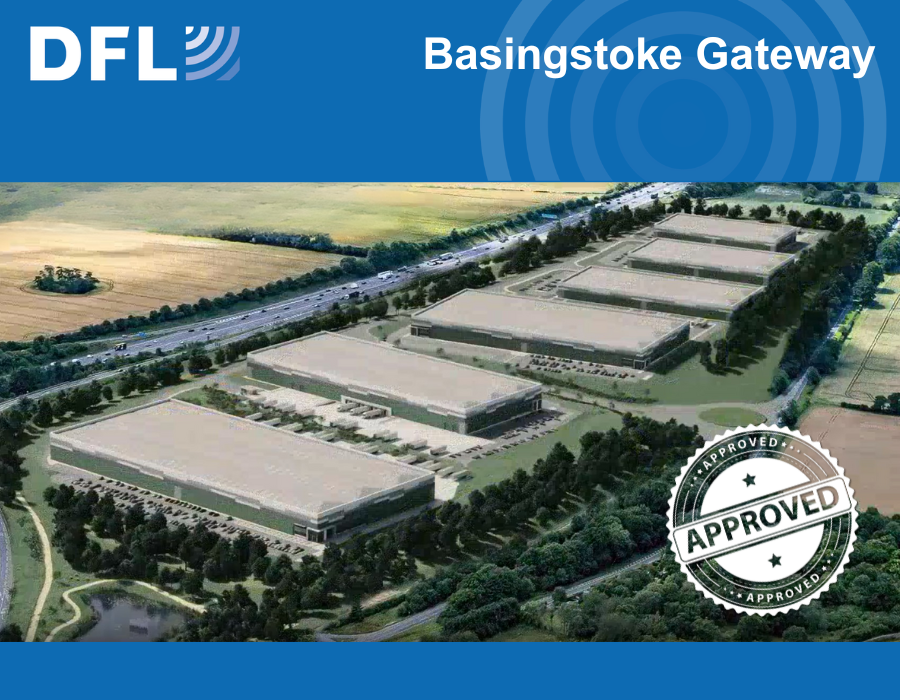
Industrial park lighting, can sometimes be the most complex lighting strategy to obtain planning for. DFL delivered a three-pronged lighting strategy, for the transformative Basingstoke Gateway development...but it wasn't easy!
The Issue
Basingstoke Gateway represents Hampshire’s most ambitious mixed-use employment and logistics developments, designed to attract investment and drive economic growth.
However, the project demanded a highly coordinated approach to lighting due to its scale, proximity to sensitive receptors, and the requirements of the local planning authority.
The site’s operational needs - which included extended working hours, large distribution units, and high-volume traffic - required dependable illumination that ensured safety, visibility, and compliance. Meanwhile, its interface with nearby residential zones, ecological corridors, and existing infrastructure placed tight controls on obtrusive light, sky glow, and environmental impact.
Our client, MBM Consulting, needed a partner capable of delivering a precise balance: an industrial park lighting solution that supported efficient 24-hour activity without compromising the amenity of neighbours or the integrity of the planning application.
This demanded an expert-led process combining technical rigour, sustainable principles, and demonstrable compliance with best practice guidance.
The Solution
DFL was appointed to produce the full industrial park lighting strategy for Basingstoke Gateway, accompanied by a detailed lighting impact assessment and comprehensive technical design. Our approach began with a contextual study of the site, using predictive modelling to understand baseline conditions, ecological sensitivities, and potential light spill scenarios.
We established a site-wide architectural lighting direction that emphasised consistency, control, and long-term sustainability.
Our solution incorporated:
- A planning-compliant lighting strategy We developed a robust strategy grounded in ILP Guidance Notes, BS EN 12464, and relevant local authority requirements. This set the framework for compliance from the earliest design stages, ensuring that all subsequent proposals aligned with planning expectations.
- A complete lighting impact assessment Using 3D modelling software, DFL demonstrated the development’s performance against spill light, glare, and sky glow thresholds, providing clear evidence to support the planning submission and showing that the lighting design remained within strict environmental parameters, even during peak operational periods.
- Energy-efficient, future-proof luminaires To minimise long-term operational costs and reduce the site’s carbon footprint, we prioritised high-efficiency LED systems with optimised distribution. Adaptive controls and dimming profiles were integrated where feasible to further limit environmental impact.
- Detailed design for construction We produced full lighting layouts and lux-level calculations for all external areas - including access roads, pedestrian routes, parking area and building facades.
The Result
The completed industrial park lighting design for Basingstoke Gateway delivered a compliant, energy-efficient, and operationally robust solution that supports the ambitions of the development. The planning authority approved the scheme subject to a Section 106 agreement.
DFL’s integrated approach enabled our client to unlock a major employment gateway for the region and setting a strong precedent for sustainable urban logistics design.
FAQs about industrial park lighting
1. What lighting levels are required for industrial estates and logistics parks?
Industrial park lighting typically requires levels that meet BS EN 12464 and relevant ILP guidance, ensuring safe vehicle circulation, clear visibility for staff, and compliance with planning requirements. Exact lux levels depend on the task areas, traffic zones, pedestrian routes and operational hours.
2. How can lighting design reduce light spill and minimise impact on nearby residents or ecology?
A well-designed scheme uses precise optics, full cut-off luminaires, adaptive controls and targeted column placement to reduce spill light. Lighting impact assessments model effects on receptors such as homes, highways and ecology to ensure compliance and protect sensitive boundaries.
3. What are the best energy-efficient lighting solutions for business parks?
Modern business parks typically use high-performance LED luminaires, smart controls, dimming profiles and zoning strategies. These reduce running costs, support sustainability goals and align with BREEAM or ESG requirements while maintaining safe operational lighting.
Do you have a similar project that you need lighting assistance on?
Let DFL take the stress out of your project.
Click the button and fill in a short form ... we can have a Quote back in your hands in no time!
Want to chat about your project? We’re all ears.